ELEVATED PLASTIC
Location: Uganda
Surface: 12.000 m²
Program: Research Center, Cultural Center, Plastic Recycling Plant
Status: Awarded Competition Proposal
Evolo
Year: 2023
Team: Anissa Le Scornet, Andrea Battistoni


In 2050, there will be 400 million people living in cities in Africa, representing one of the biggest urban challenges of our time. In its 2022 report WWF lists the impacts of plastic pollution in the African context. The health of both humans and wildlife is threatened by the exposure to toxic emissions and the ingestion of plastic elements. The ecosystems are endangered as fields and fisheries get invaded by micro-plastics. Urban floods caused by the blockage of waterways and urban drainage systems as well as a loss of tourism because of waste filled beaches impact the economy. People are specifically suffering from it in Africa because the waste management systems are often inefficient. It is worth mentioning that some western countries also send their own waste to be buried in landfills in Africa. Institutions and associations urge Africa to fill the policy gaps and establish a common vision on plastic pollution management at a continental scale.

Building Evolution
Let’s rethink the way we produce, consume, and dispose of things. Let’s take advantage of the existing waste caused by overproduction and start with what’s there to build the cities of tomorrow. Plastic waste needs to be intercepted and recycled before it reaches rivers and seas, causing irreversible damage to our ecosystems. Politicians need to adopt a coordinated life cycle approach and give an institutional framework to plastic management: study, assess, define targets, build a methodology and impose regional strategies. The tower is a model of circular construction and is a place where democracy can take place. It advocates for environmental justice and sustainable urban development.

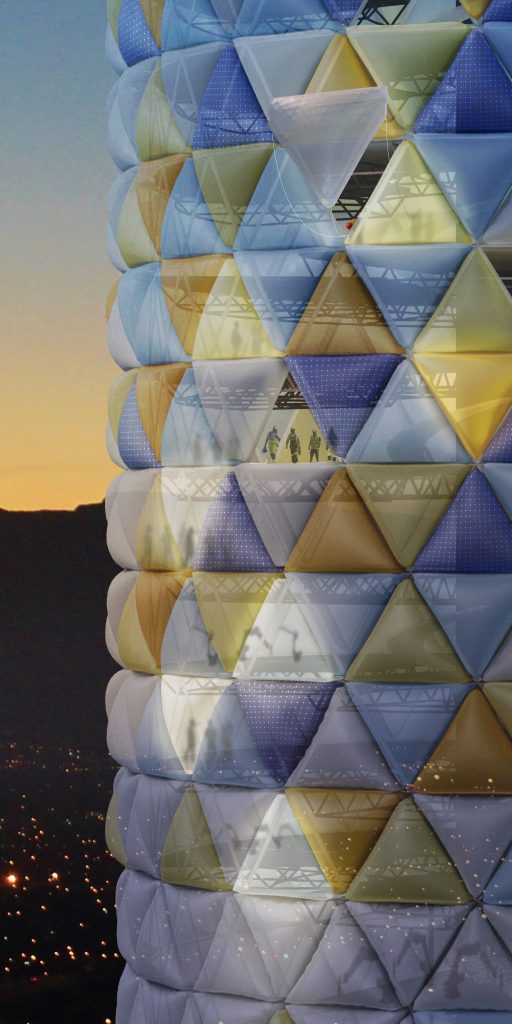
In the tower, scientists, politicians, climate activists and locals join forces to imagine and put into action a world where plastic waste could be useful. The tower, fully built out of recycled locally collected plastic and sitting on an in-situ plastic recycling plant, is a new landmark of hope, showing that another future is possible. At the top of the tower, an open amphitheater is a place where institutions can meet and discuss climatic policies. It is surrounded by balloons flying from the production labs below. These labs produce inflatable triangular modules made of plastic balloon and solid frames. Balloons are powered from the tower using renewable energy and sent to other locations to help build new sustainable buildings.
The balloons are filled by pure water vapor, produced by the plastic recycling plant of the lower levels. The air inside the balloons is heated by steam and by solar radiation. The heated air then expands and has a lower density than the surrounding air. A vent at the top can be opened to release hot air for descent and deflation. This phenomenon relies on the thermodynamics formula: PV=nRT.
The balloons’ trajectories can be determined using wind maps mirroring the pollinisation process observed among plants. Powering balloons with hot air or steam is the safest, most cost-effective, and most sustainable option on the market of inflatable balloons alimentation gaz.
The great variety of plastic materials coming from recycling offers the possibility to create different products and exploit different polymers properties. The process of production of new elements must be as flexible and diverse as its source materials can be. The use of an injection molding machine offers multiple possibilities to the design of different elements.
By creating different molds, the machine can easily produce different products in series, using one specific polymer or combining multiple according to the desired formula. The importance given to recycling is linked to the innovative approach to consumption and production that the project brings to life. To optimize the production of structural elements made of plastic, a system of robot arms is set in the design atelier, along a conveyor belt. Their precision and fast execution allows the realization of new prototypes and products.